


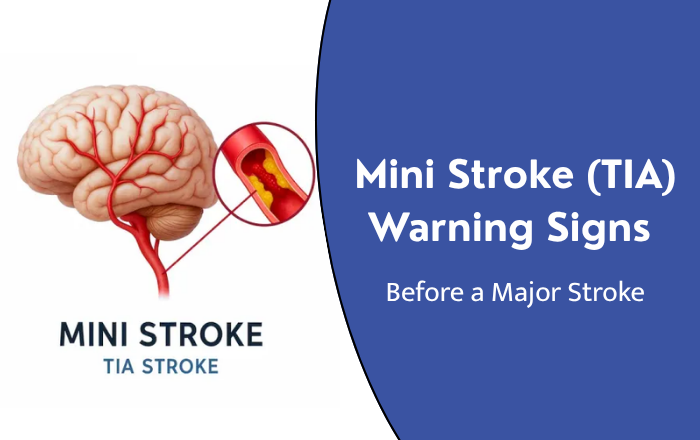
Your father is reading the newspaper when, suddenly, he can’t hold it properly. His words come out jumbled for a few minutes. Then, just as quickly, everything is back to normal. He laughs it off and blames low sugar or tiredness.
This is how a mini stroke often plays out in Indian homes. Because the symptoms disappear on their own, most families never go to the hospital. But a mini stroke, known medically as a transient ischemic attack (TIA), is one of the clearest warnings the body gives before a major stroke. If it’s taken seriously and treated on time, there is a real chance to prevent that stroke.
This guide explains what a TIA is, the warning signs to watch for, what to do when they appear and how doctors reduce the risk afterwards.
What Is a Mini Stroke (TIA)?
A TIA happens when blood flow to part of the brain is blocked for a short time, usually by a small clot or a narrowed artery. The blockage clears before it causes lasting damage to brain tissue.
A full ischemic stroke involves the same process, except the blockage stays long enough for brain cells to die. That’s why doctors never call a TIA “minor”. It is the same disease, caught at an earlier moment. You can read more about how clots form and travel in our blog on blood clots in the brain.
How Long Does a Mini Stroke Last?
Most TIA symptoms last only a few minutes, and many settle within an hour. By definition, they go away completely. The problem is that in those first few minutes, nobody can tell whether the symptoms will settle or turn into a full stroke. Every episode should be treated as an emergency.
Warning Signs of a Mini Stroke You Should Never Ignore
TIA symptoms come on suddenly and look exactly like stroke symptoms. The easiest way to remember them is BE FAST:
- B for Balance: sudden dizziness, unsteadiness or trouble walking
- E for Eyes: sudden blurred vision, double vision or loss of vision in one eye
- F for Face: one side of the face drooping, or an uneven smile
- A for Arms: weakness or numbness in an arm or leg, usually on one side of the body
- S for Speech: slurred speech, trouble finding words or understanding others
- T for Time: note when the symptoms started and get medical help immediately
Other Mini Stroke Symptoms People Often Miss
- Sudden numbness or tingling on one side of the face or body
- A brief shadow or “curtain” coming down over one eye
- Sudden confusion or difficulty following a conversation
- Sudden difficulty swallowing
Families often mistake these for acidity, low BP, weakness or a stiff neck. A useful rule: if the symptom started suddenly and affects one side of the body, think of the brain first. Gradual tingling that keeps coming back in both hands is a different story and is more often linked to nerve compression.
Why a TIA Is a Warning Before a Major Stroke
A TIA shows that the conditions for a stroke already exist inside the body. Research suggests that around 1 in 10 people who have a TIA go on to have a stroke within three months, and a large share of these strokes happen within the first 48 hours. The days right after a mini stroke are the ones that matter most.
The encouraging part is that quick assessment and the right treatment can lower this risk considerably.
Can a Mini Stroke Cause Permanent Damage?
A TIA does not leave lasting symptoms. However, MRI scans sometimes show small areas of injury even when the person feels completely normal. Repeated TIAs suggest that the underlying problem is active and needs attention.
What Causes a Transient Ischemic Attack?
The most common causes are:
- Narrowed arteries: fatty plaque building up in the neck (carotid) arteries or arteries inside the brain
- Clots from the heart: especially in people with an irregular heartbeat called atrial fibrillation
- Small vessel disease: damage to tiny brain arteries from years of high blood pressure or diabetes
Risk Factors Common in India
- High blood pressure, which often goes undiagnosed for years
- Diabetes and high cholesterol
- Smoking, bidi use and chewing tobacco or gutkha
- Heart rhythm problems
- Lack of exercise, excess weight and a high salt diet
- Age above 55 and a family history of stroke
- Long-term stress and poor sleep, which we’ve covered in Can Stress Cause a Stroke?
What to Do If You Notice Mini Stroke Symptoms
First Steps at Home
- Call 108 or 112, or go straight to the nearest hospital with CT scan and stroke care facilities.
- Note the exact time the symptoms started. Doctors use this to decide on treatment.
- Don’t give food, water or any medicine, including aspirin, unless a doctor advises it. Swallowing may be affected, and some strokes involve bleeding where aspirin can cause harm.
- Don’t wait to see if things improve on their own.
What If the Symptoms Have Already Gone?
Get checked the same day. This is the single most common mistake families make. The person feels fine, so the visit is postponed to the weekend. Yet this is exactly the window when the risk of a major stroke is highest. Stroke is one of the common neurological emergencies where hours make a difference.
How Is a TIA Diagnosed?
The doctor will ask about the symptoms, examine the nervous system and usually advise some tests to find the cause:
- CT or MRI brain to rule out bleeding and look for signs of injury
- Carotid Doppler to check for narrowing in the neck arteries
- ECG, and sometimes a 24-hour Holter test, to detect irregular heart rhythm
- Echocardiogram to look for clot sources in the heart
- Blood tests for sugar, HbA1c and cholesterol
Mini Stroke Treatment and Stroke Prevention
TIA treatment focuses on one goal: preventing the next, bigger event. The plan depends on the cause found in the tests.
1. Medicines
Doctors commonly prescribe medicines that prevent clots, cholesterol-lowering medicines, and treatment to control blood pressure and diabetes. People with atrial fibrillation may need a blood thinner. These should be taken exactly as prescribed and never stopped without medical advice.
2. Procedures for Narrowed Arteries
If a neck artery is significantly narrowed, a procedure to clean out the artery (carotid endarterectomy) or open it with a stent may be recommended. Not everyone needs this. It depends on how severe the narrowing is and on the person’s overall health.
3. Everyday Changes That Lower Stroke Risk
- Quit all forms of tobacco
- Check your BP regularly at home and keep it under control
- Walk for at least 30 minutes on most days
- Cut down on salt, fried snacks and sugary foods
- Keep diabetes and cholesterol in check with regular tests
For more practical tips, see our guide on simple ways to avoid stroke.
Frequently Asked Questions
Q1. What is the difference between a mini stroke and a stroke?
Both are caused by blocked blood flow to the brain. In a mini stroke, the blockage clears quickly and symptoms go away completely. In a stroke, the blockage lasts long enough to damage brain tissue, often leaving lasting weakness, speech or vision problems.
Q2. How long do mini stroke symptoms last?
Usually a few minutes. Many TIAs settle within an hour, and symptoms go away completely. Since a stroke looks the same at the start, any sudden symptom should be treated as an emergency.
Q3. Can a mini stroke happen to young people?
Yes. It’s more common after 55, but younger adults with high BP, diabetes, smoking, heart problems or certain blood disorders can also have a TIA.
Q4. Should I go to the hospital if the symptoms have already gone?
Yes, on the same day. The risk of a major stroke is highest in the first few days after a TIA, and early tests and treatment can lower that risk.
Q5. Can a TIA be prevented?
Many can. Controlling blood pressure, sugar and cholesterol, quitting tobacco, staying active and taking prescribed medicines regularly all reduce the chances of a TIA or stroke.
Have questions? We’re just a message away! Contact us on WhatsApp: Click Here to Chat with Us
Had a Mini Stroke or Warning Signs? Get Evaluated in Pune
A mini stroke is easy to dismiss because it passes so quickly. Seen the right way, it is an early warning that gives you time to act. Finding the cause and starting treatment early is what makes the difference.
If you or a family member has had sudden, short-lived symptoms like face drooping, arm weakness, slurred speech or vision loss, Dr. Ninad Patil, Neurosurgeon with 12+ years of experience, offers consultation at Ibhanan Clinic, Viman Nagar, Pune. He can review your scans and reports, explain what may have caused the episode and guide you on stroke care and prevention.
If symptoms are happening right now, please go to the nearest emergency department first.
Address: Ibhanan Clinic, DNK Square, 805, Airport Road, Sakore Nagar, Viman Nagar, Pune, Maharashtra 411014
👉 Chat on WhatsApp
📞 Call 84689 30399
📍 View Google Business Profile